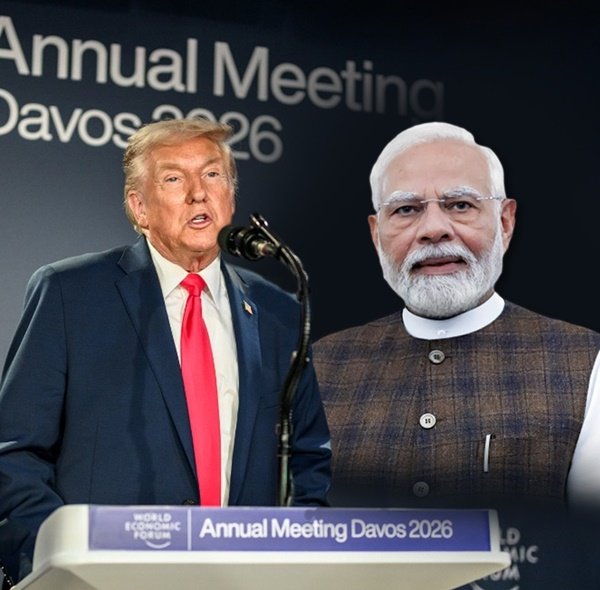
DAVOS – Amid the snowy backdrop of the 56th World Economic Forum, US President Donald Trump has signaled a potential breakthrough in the long-standing economic friction between Washington and New Delhi. Speaking on the sidelines of the summit on Wednesday, the President voiced high optimism that the United States and India would soon finalize a comprehensive Bilateral Trade Agreement (BTA).
The President’s comments come at a critical juncture for the two nations, whose trade relationship has been tested by significant tariff hikes and geopolitical complexities over the last year.
During an exclusive interaction at the summit, President Trump reinforced his personal rapport with Indian Prime Minister Narendra Modi, describing him as a “fantastic man” and a “close friend.”
“I have great respect for your Prime Minister,” Trump stated when asked about the progress of the trade talks. “He is a fantastic man and a friend of mine, and we are going to have a good deal.”
The warm rhetoric appears aimed at smoothing over recent tensions. In late 2025, the US administration imposed a 50% tariff on various Indian exports, a move the President previously characterized as a “penalty” related to India’s energy imports and geopolitical positioning. However, the tone in Davos suggests a shift toward a mutually beneficial resolution.
The proposed trade agreement, which has been in the works since early 2025, carries ambitious goals. Both nations are working toward a framework that could see bilateral trade more than double—from the current $191 billion to a staggering $500 billion by 2030.
Indian Commerce Secretary Rajesh Agrawal echoed this sentiment earlier in the week, noting that negotiations for the “first tranche” of the agreement are nearing completion. While a specific date for the signing remains unconfirmed, the President’s public vote of confidence has already sparked a rally in Indian export-focused stocks, particularly in the textile and seafood sectors.
Despite the optimism, significant hurdles remain. Negotiators are still iron out details regarding the following:
India is seeking a reduction in the 50% levies on its goods, while the US is pushing for greater market access for American agricultural products and pulses.
The “Russia factor” remains a point of discussion, as the US encourages India to further align its energy procurement with Western interests.
Rules surrounding data localization and digital services taxes continue to be part of the technical dialogue.
The global community is watching closely, as a stabilized trade relationship between the world’s two largest democracies is seen as a cornerstone for global economic stability in 2026. Analysts suggest that the President’s shift from “maximum pressure” to “confident partnership” could pave the way for a formal signing ceremony later this year.
For now, the focus remains on the “framework of understanding” being built in Davos—a sign that for Trump and Modi, personal chemistry may once again be the catalyst for major policy shifts.
Also Read : US President Rules Out Force in Greenland Pursuit; Scraps Planned Tariffs on European Allies