NEW DELHI – In a significant upgrade to the nation’s long-term economic outlook, Chief Economic Adviser (CEA) V. Anantha Nageswaran announced on Thursday that India’s potential GDP growth rate has accelerated to 7%. This is a notable increase from the 6.5% estimate held just three years ago, signaling a structural shift in the country’s economic capabilities.
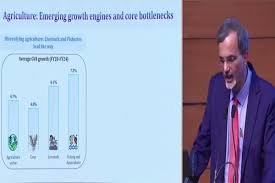
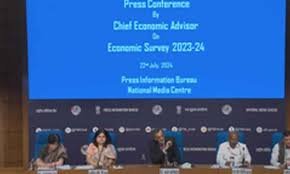
Addressing the media following the tabling of the Economic Survey 2025-26 in Parliament, Mr. Nageswaran described India as an “oasis of economic performance” amidst a volatile global landscape.
The CEA highlighted that the “reform express” of the last few years has successfully pushed the economy’s trend growth upward. While the current fiscal year (FY26) is projected to see a real GDP growth of 7.4%, the official upgrade of the potential growth rate to 7% suggests that the economy can now sustain higher speeds without triggering overheating or excessive inflation.
“The evidence presented in this Survey shows that India’s growth momentum is intact,” Mr. Nageswaran stated. He further noted that if India continues to address key “boxes” such as land reforms, manufacturing competitiveness, and export surplus, this potential could even touch 7.5% or 8% in the coming years.
Key Drivers of the 7% Surge is that the upward revision is anchored by several domestic strengths that have shielded India from global “systemic shock” scenarios:
Private final consumption expenditure is estimated to grow at 7% this year, accounting for over 61% of the GDP—the highest share since 2012.
Capital Formation: Real gross fixed capital formation (investment) is expected to grow by 7.8% in FY26, significantly outperforming the pre-pandemic average.
The manufacturing sector has emerged as a primary driver, expanding by 8.4% due to improved capacity utilization and resilient domestic demand.
The Centre remains on track to achieve a fiscal deficit target of 4.4% for FY26, supported by buoyant tax revenues and a widening tax base.
Despite the optimistic domestic outlook, the CEA cautioned that India is not entirely insulated from global headwinds. He identified “external uncertainties”—rather than immediate macroeconomic stress—as the primary challenge.
Mr. Nageswaran pointed out that while inflation remains “tamed and anchored” at an average of 1.7% (April–December 2025), global trade fragmentation and currency volatility require a focus on “strategic resilience.” He emphasized the role of ‘Swadeshi’ as a legitimate policy tool in an era where international trade is no longer strictly reciprocal.
The Economic Survey projects a real GDP growth range of 6.8% to 7.2% for the next financial year (FY27). This projection reflects a conservative yet confident stance, accounting for potential global shocks while banking on the “multiplier effects” of the government’s massive infrastructure outlays, which have nearly doubled since FY22.
Concluding his briefing with a nod to the future, the CEA quoted poet Robert Frost, reminding stakeholders that while India has achieved “stellar” fundamentals, there are still “miles to go” in the journey toward becoming a developed nation by 2047.
Read Also : Markets Navigate Pre-Budget Volatility Amid India-EU Trade Optimism