The images of Jupiter now available from various NASA missions offer two contrasting but equally compelling views: majestic wide-angle shots from afar, and razor-sharp close-ups that highlight the planet’s tumultuous atmosphere and storms.
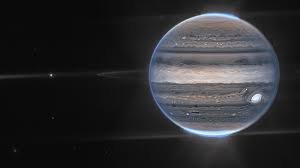
- NASA’s image archive describes a gallery of Jupiter photos going back decades, tracing how missions have improved our view of the gas giant.
- The mission Juno, orbiting Jupiter since 2016, uses its JunoCam to capture detailed views of Jupiter’s poles, cloud tops and swirling storms.
Why the “near” images matter
When a spacecraft flies close, every image can reveal surprising new details:
- Close passes have allowed views of Jupiter’s poles, which were previously unseen in such detail.
- The swirling belts, vortices and the iconic Great Red Spot (a massive storm larger than Earth) appear in high-resolution colour for scientists to examine atmospheric dynamics.
- Near-field images help scientists understand the internal structure, weather systems and magnetic field of Jupiter — insights that distant views alone cannot provide.
Why the “far” images are just as important
Though close-up photos are dramatic, wide or distant views serve key purposes:
- They provide context: showing Jupiter in relation to its many moons, its rings and the solar system environment.
- They enable monitoring of global changes over time — for example how the cloud bands shift, or how storms evolve across the planet.
- They help the public appreciate Jupiter as a magnificent whole, rather than just a swirling blob of gas: the scale, the colour, the majestic presence of the gas giant becomes visible.
Key takeaways from the image collections
- The images span decades of exploration, from earlier missions (e.g., Galileo) to modern orbiters like Juno.
- The variety of perspectives (distance, angle, wavelength) reveals Jupiter’s complexity: storms, auroras, magnetic effects, polar dynamics.
- High-quality imagery supports scientific analysis — of atmospheric flows, weather patterns, magnetospheric interactions — and helps engage global audiences with space exploration.
What’s next?
Future missions and ongoing data analysis will continue to refresh how we see Jupiter. For instance:
- Continued orbits of Juno and extended mission phases will provide newer images from different angles, altitudes and lighting conditions.
- Upcoming missions to Jupiter’s moons (such as the planned Europa Clipper) will complement Jupiter-centric imagery with views of the Jovian system.
- Advances in image processing will allow both scientists and amateurs to extract more detail and even make 3-D reconstructions of Jupiter’s dynamic atmosphere.
Final word
The “photos of Jupiter from NASA spacecraft” are more than just amazing images — they are windows into the giant planet’s nature, history and dynamics. Whether captured from afar or zoomed in close, each photograph helps us learn, appreciate and connect with one of the most awe-inspiring worlds in our solar system.